
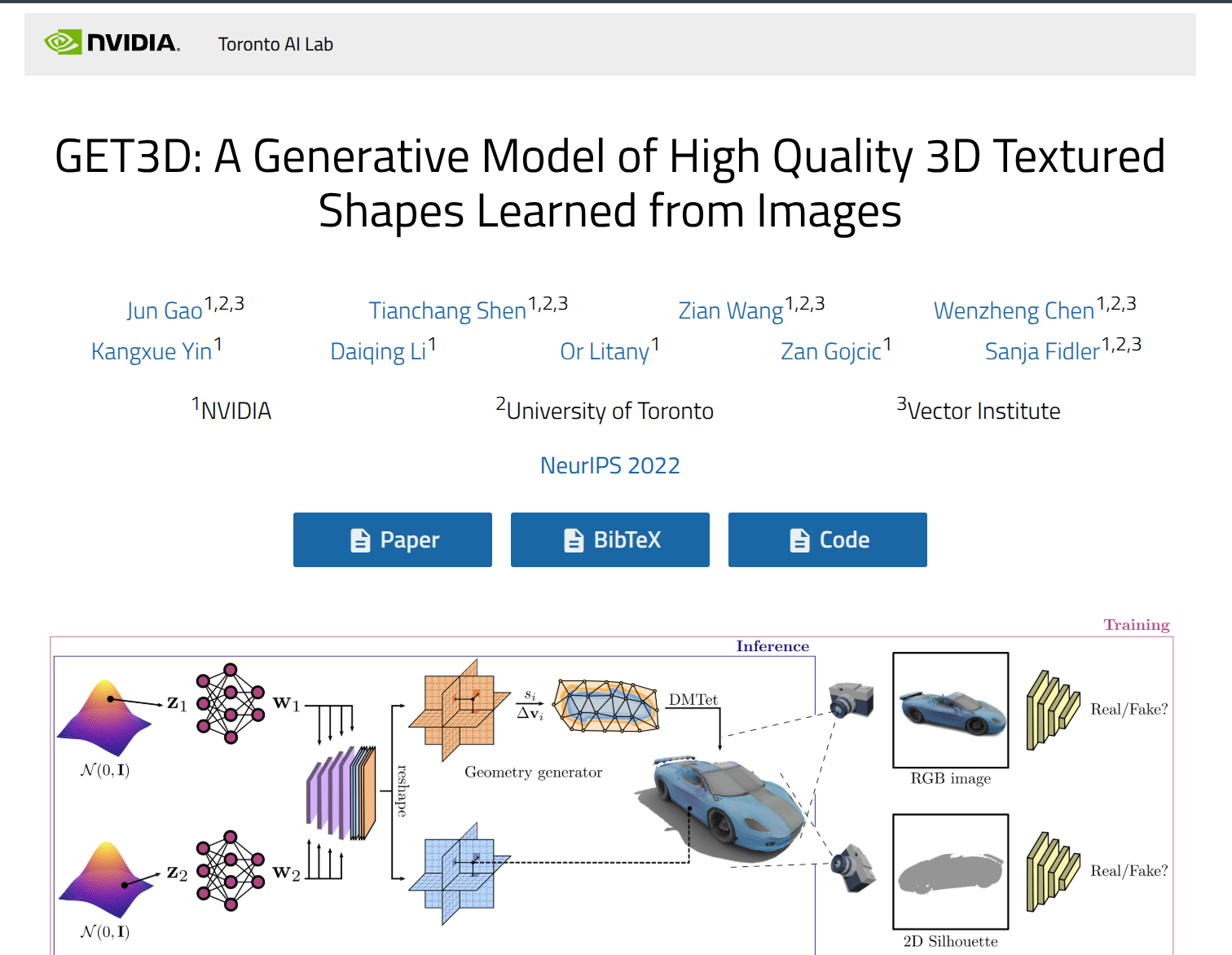
« NVIDIA GET3D is a generative AI research model developed by NVIDIA Research for creating detailed, textured 3D objects from 2D image collections. »
📖 About Get3D Nvidia
NVIDIA GET3D is a generative AI research model developed by NVIDIA Research for creating detailed, textured 3D objects from 2D image collections. Rather than producing only a visual representation, GET3D directly generates explicit 3D textured meshes with complex geometry and varied topologies, making the results suitable for use in conventional 3D workflows.
GET3D can create a broad range of assets, including cars, chairs, animals, motorcycles, human characters, and buildings. Its generated meshes include both geometric details and high-fidelity textures, allowing them to be used in rendering engines and further edited with standard 3D software.
The technology was developed with large-scale virtual environments in mind, where manually modeling thousands of unique objects can be extremely time-consuming. NVIDIA has highlighted potential applications across gaming, robotics, architecture, virtual worlds, and social platforms.
GET3D is particularly notable for connecting image-based learning with usable 3D asset generation, helping researchers and creators explore faster ways to populate digital environments with diverse 3D content.
GET3D can create a broad range of assets, including cars, chairs, animals, motorcycles, human characters, and buildings. Its generated meshes include both geometric details and high-fidelity textures, allowing them to be used in rendering engines and further edited with standard 3D software.
The technology was developed with large-scale virtual environments in mind, where manually modeling thousands of unique objects can be extremely time-consuming. NVIDIA has highlighted potential applications across gaming, robotics, architecture, virtual worlds, and social platforms.
GET3D is particularly notable for connecting image-based learning with usable 3D asset generation, helping researchers and creators explore faster ways to populate digital environments with diverse 3D content.
AI Tools Like Get3D Nvidia
More tools from 3D model

Leonardo AI
3D model
A complete design platform that generates professional images, 3D textures and designs. Cr...

Meta SAM 3D
3D model
econstruct objects and humans in 3D from a simple photo: SAM 3D Objects creates detailed s...

Genie by Lumalabs
3D model
Design 3D models with a variety of settings (animated transitions, particle scales or dens...

Tripo AI
3D model
Tripo AI is an AI-powered 3D creation platform designed to turn text, images, and multiple...

Hunyuan3D
3D model
Hunyuan3D is Tencent’s AI-powered 3D generation technology, created to turn simple ideas a...

Hitem3D
3D model
Hitem3D is an AI-powered 3D generation platform developed by Math Magic, built to transfor...
🔗 Useful Links
Comments (0)
Be the first to comment!